The Outcomes Standard™ for Early Intervention

Identify risk early, support officers sooner, and elevate overall agency performance
The Difference is in the Numbers

Real results, documented across our partner agencies. When agencies put First Sign to work, the impact shows up where it matters most, measured over time and validated by independent research.

72%

reduction in officer injuries

47%

fewer citizen complaints

20%

reduction in force events

63%

reduction in severity of force

50%

fewer reported PTSD symptoms

Figures reflect outcomes documented across Benchmark partner agencies and Washington State University research. Actual results vary by agency.

Beyond Threshold-Based Systems

First Sign Early Intervention goes beyond threshold-based early warning systems.

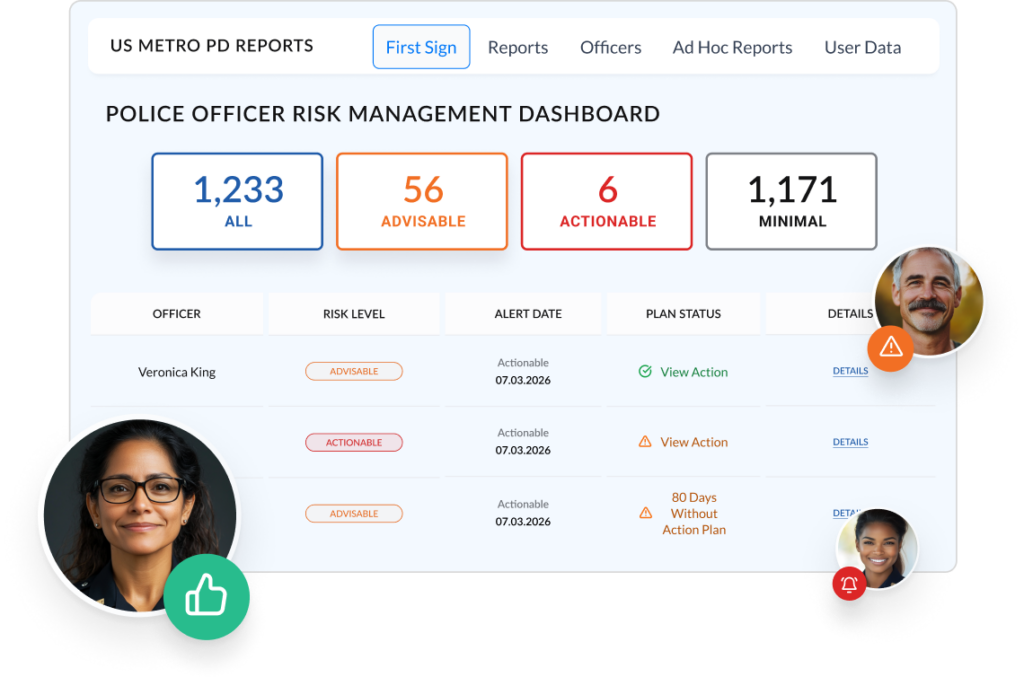
Grounded in our partnership with the University of Chicago, it tracks more than 20 event markers shown to lead to at-risk behavior, giving supervisors a clear risk-level overview of their officers and real-time alerts as adverse or out-of-policy events occur.

The result is proactive, career-saving intervention and support, delivered early enough to matter.

Not Every Officer Who Uses Force Is at Risk

High activity isn’t the same as high risk. An officer who uses more force isn’t necessarily an officer who’s struggling, and treating them the same is exactly where threshold-based systems fail.

First Sign understands the difference, identifying the officers genuinely at risk of an adverse incident without penalizing those who are simply doing a demanding job.


First Sign Early Intervention vs. the Competition

Traditional EIS offerings rely on often inaccurate threshold-based triggers to flag off-track officer behavior. These false positives and false negatives result in inefficient use of resources, time, and money, all while negatively impacting officer morale. First Sign Early Intervention incorporates decades of evidence-based research, robust information sources, and sophisticated analytics to identify officers truly in need of intervention.

First sign

85% Efficacy Rate

Got it Right:

17 Accurate Flags

Icon of a police officer in green
Icon of a police officer in gray with an exclamation mark
Icon of a police officer in green
Icon of a police officer in gray with an exclamation mark
Icon of a police officer in green
Icon of a police officer in gray with an exclamation mark
Icon of a police officer in green

TRADITIONAL EIS

71% Fallacy Rate

Got it Wrong:

14 Incorrect Flags

Icon of a police officer in gray
Icon of a police officer in red with an exclamation mark
Icon of a police officer in gray
Icon of a police officer in red with an exclamation mark
Icon of a police officer in gray
Icon of a police officer in red with an exclamation mark
Icon of a police officer in gray
Icon of a police officer in red with an exclamation mark
Icon of a police officer in gray
Icon of a police officer in red with an exclamation mark

First Sign is Your Clear Choice for a Transformative EIS Designed to:

  • Identify problematic officers within your department
  • Retain and boost morale of high-performing officers
  • Improve community relations and regain public trust
  • Reduce resource needs, administrative burden, and costs
  • Lower exposure to liability claims from increasing litigations

The Science Behind the Prediction

Benchmark has the world’s largest multi-jurisdictional database on officer performance, and our predictive analytics have been validated through a standardized national model developed in partnership with the University of Chicago.

5+

Data Sources

+

Informed by In-Depth Data Points

  • Officer attributes
  • Arrest history
  • Use of force
  • Internal affairs
  • Assignment history

91

Model Variables

+

Driven by Complex, Nuanced Factors

  • Context of adverse incidents
  • Sequence of events
  • Patterns of behavior
  • Peer comparisons

85%

Model Precision

+

Greater Accuracy Than Any Other EIS

  • 2X more precise than most systems
  • Uses advanced research methodologies
  • Employs high-level predictive modeling

5%

At-Risk Average

+

Police Officers Truly in Need of Intervention

  • Identifies who will be involved in an adverse incident within 12 months
  • Findings show no more than 5% of officers at-risk
  • Clears officers often flagged incorrectly by most systems

66%

Incident Rate

+

Perpetuated by 5%
At-Risk Officers

  • Those inflicting most injuries on the job
  • Officers using disproportionate force

Take Early Intervention to the Next Level

Benchmark’s industry-leading EIS is helping prevent adverse officer events at agencies across the U.S. Find out what makes our solution unique.

A Multi-Dimensional EIS Built on Six Key Pillars of Success

Photo of the University of Chicago with logo

Research Legacy

Grounded in our partnership with the world-renowned University of Chicago — leveraging the high volume of data, research, analytics and longitudinal studies in the field of law enforcement.

  • Features over a decade of in-depth research into detailed historical data about officer behaviors in policing
  • Includes a team of 20+ data scientists who have created a series of predictive models and algorithms that identify patterns of conduct that lead to problematic behavior
  • Identifies the factors that truly matter in alerting problematic behavior — significantly increasing the efficacy rate of First Sign versus existing trigger-based EIS offerings
  • Represents the world’s largest multi-jurisdictional officer performance database with over 80 million records

First Sign offers you the ONLY research-based, data-driven EIS available in policing today.

Academic credibility image early intervention

Academic Credibility

Facilitated by the dedicated work of the National Police Early Intervention and Outcomes Research Consortium – led by the University of Chicago – along with a team of public safety PhD academicians.

  • Includes support of The Joyce Foundation to accelerate research and best practices for early intervention of police misconduct
  • Draws on data from Benchmark Analytics covering virtually every aspect of police operations . . . e.g., organizational structure, training, use of force, complaints, internal affairs, discipline and more
  • Focuses on leveraging data captured to drive change and help inform outcomes, policies and processes
  • Assesses current interventions for effectiveness, behavior modification and recommended improvements
Scientific legitimacy pillars early intervention

Scientific Legitimacy

Uniquely positioned with one full patent* and one provisional patent filed with the United States Patent and Trademark Office.

  • Preserves key features of our groundbreaking EIS based on decades of evidence-based research in policing
  • Draws on data from Benchmark Analytics covering virtually every aspect of police operations . . . e.g., organizational structure, training, use of force, complaints, internal affairs, discipline and more
  • Focuses on leveraging data captured to drive change and help inform outcomes, policies and processes
  • Promotes customer confidence in our advanced, first-in-class and proven EIS platform

*U.S. Patent No. 11,915,180 B2

Iterative learning pillars early intervention

Iterative Learning

Provided by ongoing, cumulative analytics of all partner data to ensure the First Sign platform evolves — getting smarter and more efficient over time.

  • Uncovers trends and highlights best practices
  • Provides new insights and directs technological advancements
  • Supports recommended actions and platform modifications
  • Continues to optimize risk management and reduce exposure to rising liability costs
Compliance ready image early intervention

Compliance Ready

Configured to help police agencies comply with major law enforcement organization directives, recommendations and standards.

  • Supports agencies seeking accreditation by the Commission on Accreditation for Law Enforcement Agencies (CALEA)
  • Includes best practices and elements of the ethics toolkit developed by the International Association of Chiefs of Police (IACP)
  • Aligns with performance guidelines on officer conduct recommended by the Department of Justice (DOJ)
Reciprocal officer support image early intervention

Reciprocal Officer Support

Offered by C.A.R.E. — our innovative, proactive police officer support platform developed to help officers who have fallen off track get back on track.

  • Facilitates support plan with a template of actionable steps, guidelines and goals for implementation
  • Features research-based management modules for officer-specific interventions
  • Provides “benchmarks” of best practices proven to be most effective for different levels of intervention
  • Fully automates critical tracking points and follow-up measures to help secure successful support outcomes

Frequently Asked Questions

What to know on the way to measurable outcomes.

Close All Open All

An early intervention system flags officers showing patterns that may lead to adverse
outcomes, so supervisors can offer support before an incident occurs. First Sign Early
Intervention
uses a predictive model co-developed with the University of Chicago to identify
those patterns earlier and more accurately than threshold-based systems.

First Sign Early Intervention reaches 85% model precision, compared with roughly 30% for threshold-based
systems that trigger only after a fixed count is crossed. Higher precision means fewer false
positives and false negatives, so agencies focus resources on the officers who genuinely need
support

No. First Sign Early Intervention is built for support, not discipline. It surfaces officers who may
benefit from proactive intervention, wellness resources, or training, with the goal of keeping
careers on track rather than building a disciplinary file.

First Sign Early Intervention draws on data covering virtually every aspect of police operations, including training, use of force, complaints, internal affairs, and discipline, analyzed across the largest multi-
jurisdictional officer-performance database in policing (80 million records).

Request a Demo

See What the Outcomes StandardTM Looks Like for Your Agency

Request a one-on-one demo and we’ll show you how Benchmark turns your personnel data into measurable performance outcomes, built for the way your agency works.

Complete this form and we’ll be in touch with you shortly!