


One call, eight skills, and an FTO with no time to log them
End-of-shift entry turns into hours of reconstruction. Real-time capture keeps the record honest.
A domestic comes in midway through phase two. The trainee drives it lights and sirens, works the radio, makes a clean arrest, writes the case report, and hands the victim a resource guide. The field training officer (FTO) has to document all of it. With software built around end-of-shift entry, that means going back into the daily observation report (DOR) hours later to log, link, and write up each skill.
What does one call cost in daily observation report work?
For a domestic, there are typically eight separate skills to document: emergency driving, emergency radio use, scene safety, interviewing the parties, the arrest, safe arrest procedure, the criminal case report, and the victim resource guide.
However, an FTO running back-to-back calls doesn’t have time to complete the DOR in real time. That waits until the end of an eight-hour day, when the FTO sits down to rebuild the whole shift from memory, call by call and skill by skill.
That’s the part agencies that implement field training software often don’t expect. Moving to software put the form on a screen, but it didn’t change when the FTO fills it out or how long it takes.
Why do daily observation reports fall behind?
Benchmark Analytics’ Mark Pfetzer, who ran field training as an FTO and coordinator at the San Juan County (NM) Sheriff’s Office, described how it compounds.
“You don’t have a free minute to do the DOR until the end of the shift, but then you get a late call and put it off until the morning. You come in the next day to a call right off the bat, and you’re off and running for the day.”
Now the FTO is partway through day two and still owes day one. Pfetzer was fair about why. “Sometimes it’s because of poor time management,” he said. “But there are many times when it’s not, and it’s truly because you just couldn’t get to it.” Long calls and night shifts make it worse. That catch-up time also shows up as overtime, which we covered in an earlier post.
What does a trainee lose when the DOR is late?


A trainee who goes home without a DOR doesn’t know what to keep doing or what to fix, so they start the next shift guessing. FTOs give feedback on scene and in the car, but the feedback loop created by the DOR is what makes it stick.
“It doesn’t do the trainee any good if they leave without an understanding of their performance. They start the next day in a deficit, because they don’t know what behavior to repeat and what needs improvement,” Pfetzer said.
A late DOR becomes a problem inherited by the next FTO, too. If someone else rides with the trainee tomorrow, yesterday’s evaluation is how they know where the trainee stands.
Where do an FTO’s notes go now?
Good FTOs already document in the moment. They scratch notes between calls, then transcribe them hours later into the system. “I used to keep a notebook in my pocket and took notes throughout the shift,” Pfetzer said.
So, the ask isn’t for FTOs to start documenting during the shift. They already do. The problem is that the system can’t read what’s in the notebook. Benchmark’s Ashley Olsen, a former FTO and sergeant, suggests typing the notes into the system after each call, while FTOs are debriefing with their trainee anyways.
“If your notes are already in, you’ll have a starting point when you come back at the end of shift. If you have time to write a full narrative, great, but a lot of people don’t.”
Pfetzer agrees. “It’s a lot easier to take 30 seconds after a call and fill in that information. Then you don’t have to rely on memory later.” And when a big call keeps the FTO away from the car for hours, “at least you only have to remember the last half of the day.”
What does “finish before you leave the lot” actually mean?
The DOR should be mostly built by the time the shift ends, so the last step is reviewing and signing it, not rebuilding the day. It doesn’t mean every entry happens on scene.
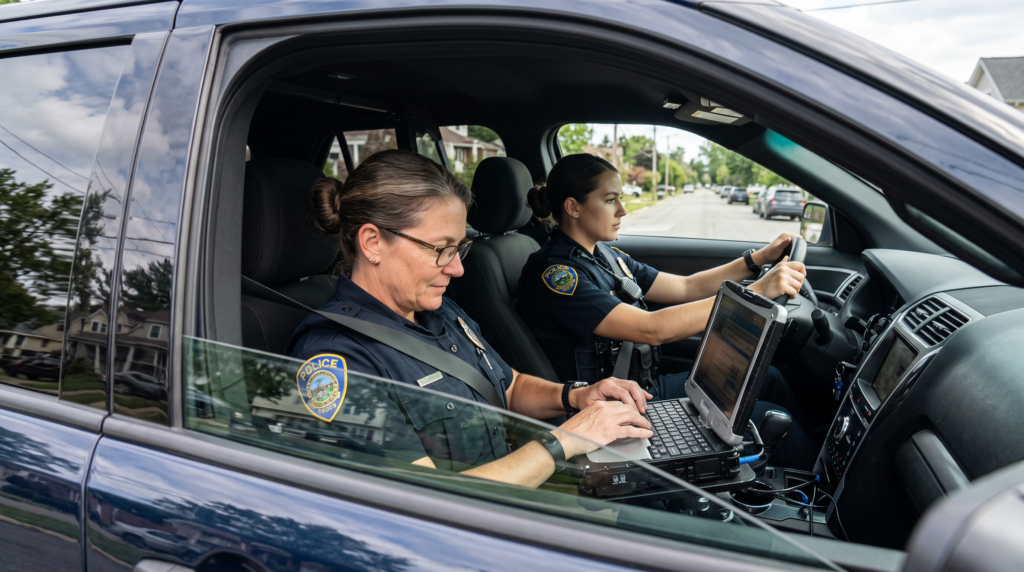
Phase matters. In phase one, the FTO is driving, so notes go in during the debrief or once the car is parked. By phase two, the trainee drives and the FTO’s hands are free. “You can whip this MDT over to me and type this stuff in. Super simple,” Pfetzer said. For the days when none of that works, the traditional end-of-shift form stays on the same page.
Where does the software help, and where does it stop?

Software helps with capture and structure, and it stops at judgment. When an FTO logs a call, the Field Training module within the Benchmark Management System® (BMS) suggests the skills that usually go with that call type, so a domestic surfaces the eight skills we talked about earlier. The FTO adds or removes skills and types notes, and the notes stay in the FTO’s own words.
At the end of the shift, the logged calls come together into the daily observation report and checklist entries, labeled as a draft. The FTO reviews and edits it, sets every rating, and signs. Nothing is scored for them. The assist can also be switched off, and an agency that wants only the traditional DOR gets exactly that.
Why does the last call of the shift shape the whole evaluation?
A DOR written from memory is often weighted toward the last thing that happened. Both Pfetzer and Olsen agreed. A trainee can run six solid calls and struggle on the seventh, and the seventh is what the FTO remembers at the keyboard.
Olsen saw it often enough as a supervisor that she had to coach her FTOs out of it directly. Pfetzer’s comparison is the one any officer will recognize. “None of us want our supervisor to write our annual performance evaluation based on the most recent month,” he said. “We want our evaluation to include our whole rating period.”
Every FTO has written a worse evaluation than a trainee earned because the shift ended badly. Logging each call while it’s fresh won’t end recency bias, but it puts the morning’s solid traffic stop on the record next to the evening’s mistake, where it belongs.
What changes when the DOR is built call by call?
Notes typed after each call become the starting point for the daily observation report instead of a pocket notebook that has to be transcribed at the end of a long day.
The trainee goes home knowing what to repeat and what to fix. The next FTO picks up a current record instead of a gap. And the evaluation reflects the whole shift. As Pfetzer put it, “It gives everyone a more accurate picture.”
Frequently Asked Questions
A daily observation report (DOR) is a field training officer’s evaluation of a trainee’s performance for one shift. It rates set categories, like officer safety and report writing, with a narrative explaining each score.
The same shift, ideally. A DOR that waits a day could lose detail, and the trainee starts the next shift without feedback. Logging notes after each call makes finishing before you go home realistic.
No, it feeds it. Notes logged after each call become the starting point for the end-of-shift daily observation report, which the FTO still reviews, scores, and signs.
No. The officer sets every rating and signs the DOR. Anything the system assembles is labeled a draft, and the assist can be turned off.